Monday, November 3, 2014

Investigative Journalism

http://cironline.org/reports/female-inmates-sterilized-california-prisons-without-approval-4917

Investigative journalism is something that easily grabs the attention of readers because it illuminates information that has been previously hidden to the readers. Readers always want to be learning something new, and for this article, the illegal sterilization of female inmates in prison was investigated and reported on.
                This article does not lack in credible sources at all, and information was gathered from officials employed by the prisons accused, while also remaining balanced and gathering opinions and accounts from the inmates themselves. By adding the stories of the women inside the prison, it adds credibility to the story by expressing the alleged real problem from firsthand accounts.
                The Journalists discovered that there is a possibility of females in prison being pressured, and sometimes ill-informed, into getting a sterilizing injection to prevent any reproduction. They clearly hinted that there was some conflicts of interest once the number of children got to a certain amount, and it seemed by this article that the medical professionals inside the prisons were advised to sterilize inmates and prevent reproduction. The exact reason as to why medical professionals were doing this remains to be seen, but that answer is left up to the reader to imagine.

                This project can have an enormous impact on society, especially since prison is such a large part of our society. The best investigative journalism uncovers information that follows the criteria for regular news, but more-so how the information relates to the audience. If our criminal justice system is responsible for sterilizing inmates to prevent reproduction of our species, it adds moral and legal implications which could affect every single person in our society. 

Wednesday, October 8, 2014

Best Photos


From a journalist's aspect, this photo is extremely powerful. First of all, it is a picture of a child which always is a joy for the reader to see being that the innocence of children is appealing. Second off, the blurred background reveals some armed military force, presenting a clashing of ideals. And to round it all off, the picture obeys the rule of thirds, as the main focal point (the child) is not positioned exactly in the center.


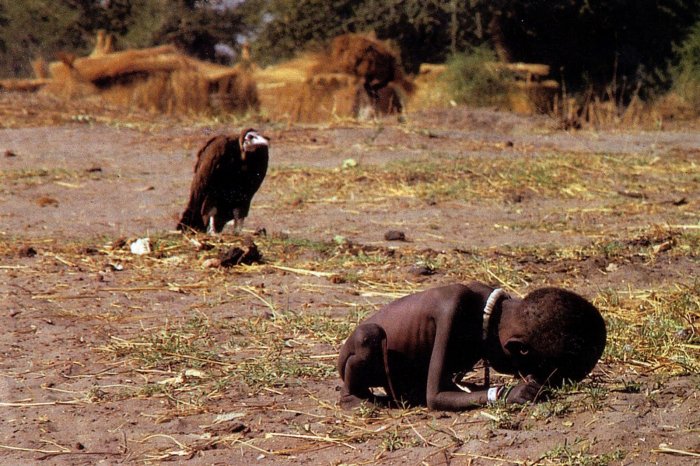
This photo is equally, if not more powerful than the first. Once again it is of a child, but this child is clearly starved and famished as the rib cage is visible. It shows truly the magnitude of poverty in Sudan, as a vulture is viewing a human child as prey. It also obeys the rule of thirds from both focal points, as neither the child nor the vulture is directly in the center of the frame. The photographer who took this picture actually ended up committing suicide a couple months later.

Tuesday, October 7, 2014

Professor and Student Team Up to Open Restaurant

Are you looking to add some variety to your college diet? Although we all love Ramen Noodles and Easy Mac every now and then, UW-L Professor Vivek Pande and fellow student Don Greengrass, the co-founders of Greengrass Café, believe they have created a refreshing change of pace.
Located across the street from Cartwright Center at 1904 Campbell Road, The Greengrass Café has one goal in mind: to make the restaurant enjoyable for anyone that appreciates good food. The dynamic duo of Don and Dr. Pande have suited their restaurant to entertain customers of all ages. Children have the option of playing with toys offered at the door, or even watching cartoons on one of the many flat screens that line the walls. Although college students and older will find cartoons entertaining, the restaurant is equipped with a full bar to appeal to the mature crowd. This colorful splash of a restaurant, whose 35-plus employees are mainly UW-L students and ex-students, places emphasis on ordering good food from local businesses: “We have the highest quality of food,” says Dr. Pande, “and price it about as rock bottom as we can.”
While being a full-time Business Management and Marketing student, as well as an on-call employee at all times, student Don Greengrass remains excited for the opportunity. Greengrass grew up in the neighborhood, and has always had aspirations of starting a restaurant. Upon enrolling in one of Dr. Pande’s business law classes, Don and Vivek have developed a long-lasting friendship that has since turned professional. This unique combination of lively personalities believe their extensive experience working in the food industry has prepared them for the challenge, a challenge they are more than willing to accept. Their idea is simple: to eliminate a specific target market and create an accurate depiction of life in La Crosse, bringing the community together under one roof.
Although Greengrass Café has become a sight for sore eyes, the past 8 months have been anything but a piece-of-cake. These business partners renovated the building entirely, as a full construction project was necessary to get the place up and running on August 26th. The restaurant plans to establish a clean, crisp, and colorful identity, something that could give them a leg up on competitors. With the failure rate of restaurants being roughly 60% now-a-days, it’s all a matter of the competition: something Don isn’t too frightened by. “Personally, the more competition there is, the better,” he said, “I like competition, it breeds excellence.”

Melanie Tatge, a graduate student at UW-L and first-time customer at Greengrass Café, was pleased with her experience: “I really liked the atmosphere. I love that it’s so close to campus so I can go and get breakfast before class.” This is exactly what Dr. Pande believes will be a catalyst for the restaurant’s success: “come and eat at a place which is owned by one of your colleagues,” he said, “If you have a study group or project group, why not meet here over breakfast?”

Tuesday, September 30, 2014

Analysis of Leads


The lead of this article is that Lindsey Vonn, a former Olympic champion recovering from two knee injuries, is warning her competitors that she will be back, and more dominant than ever. The article is written very well, as it is about famous people, and contains many powerful quotes. I thought the structure is cool because it pins the story as the underdog overcoming the injury, and explains Lindsey Vonn’s road to recovery and perseverance. And at the very end of the article, it brings up Lindsey Vonn’s relationship with Tiger Woods, someone of even bigger stardom than her. They are dating, so that made for good celebrity gossip.


The Lead of this article is the response of the Chief of Secret Service’s response to a man breaking into the white house, successfully making it past security that clearly should have stopped him. The article does a good job of reporting factually, and mentions a “fire-back” response from someone of authority- Stephen Lynch. He gives a powerful quote that adds conflict to the story. I think this is a powerful story because the American people want to know that their leader is in protective hands at all times. A quote from the Chief of Secret Service saying everything will be okay reassures many Americans.


This is deemed a “science” article about the progress of the Ebola outbreak. The lead states that the outbreak in Nigeria is being contained, and through powerful quotes from influential people (the president of the CDC), it achieves the same goal that the second article did. Ebola was a scary thing for many Americans, and we were all told that we should be worried about an outbreak. With patients being flown into the United States, the matter now affected all of us. With news being delivered that the outbreak is possible to contain, I believe it relieves a lot of Americans.


Wednesday, September 24, 2014

Open Forum- UWL

On September 23rd, an open forum was conducted by Joe Gow as a way for higher authorities to answer questions that everyday citizens had about the city they live in. Upon arrival, I immediately felt out of place because of my choice of attire for the day as I sat next to an older gentleman with a tie zipping together a freshly ironed shirt, probably too fresh because of the burning smell that I couldn’t get out of my nose, which prompted my early departure. The meeting began with Joe Gow breaking down the barrier between the audience and himself and creating an open-discussion format in which anyone could pose a question they had. The first question was asked by a woman who couldn’t wait any longer to ask it: “because I got a parking ticket today, I would like to know more about where we’re at with the parking structure and any of the other street plans that they’re considering.” A man by the name of Bob stood up confidently and  replied by exposing the woman’s actual story- being that she parked in a place that she couldn’t, and that she just got “busted.” Bob continued on by revealing a lot of useful information regarding parking in La Crosse. Some of this information included- building up levels 4 and 5 to the parking ramp while students leave campus for spring break, the parking ramp being built by the same company that made Centennial, the decreasing availability of parking permits, and an increasing trend of restriction of parking policies in the city. 

Thursday, September 18, 2014

Culture Shock: School on a Different Continent

With September coming and going in a flash, it is now time for students to nestle into their classes and form a rhythm. For many, the daily life is vastly different from what they had become accustomed to the prior three months. The change in scenery is sometimes an obstacle to dodge in assuring a successful semester. But for Vivi, a 20 year old academic junior from the large Southern Chinese city of Hechi (pronounced Huh Cha) , the leap spans continents.

Vivi, a participant of the "2plus2" program here at UW-L, is on her third year of the program, but her first year in the U.S. 2plus2 is a program designed to allow international students to complete two years of higher education where they originally desire, then transfer to an American 4-year university to obtain a Bachelors Degree- a degree in which Vivi is pursuing with great perseverance. She is pursuing a job in teaching English as a second language, while also attempting to grasp the culture shock of landing in the states. “Its different,” Vivi stated, “With America, its all about freedom.” 

Some of the differences in culture Vivi also elaborated on ranged from the withstanding freedom of America, the population change from Hechi (approximately 3,991,900 people) to La Crosse (approximately 51,000 people),  and the differences in drinking age, being that Hechi’s drinking age is non-existent: “In China, everyone can buy beer.”La Crosse is not the only city in America she has seen, she also visited the Big Apple- a city in which she didn’t seem exactly fond of, especially of the public transportation, “The public transportation is so old, in China its very fashionable,” she continued, “It’s a symbol of the city, why haven’t they changed it?”


The culture shock is presumably an aspect of school many students, especially ones who aren’t studying abroad and have a general understand of American culture, take for granted and never experience. As if a 16 hour flight to live in a city she has never seen before wasn’t enough to take in at once, Vivi is also now separated from her boyfriend, who still lives in Hechi. Vivi and Cooky, her boyfriend of 2 years, still remain in contact every day, “In your heart you know you love him.” 

If I had more time, I would have asked: What is your favorite class so far, and does that class relate to previous notions of the cultural gap?
What do you plan on accomplishing in your two years in the United States?
Do you ever plan on coming back to the US after you leave?

Wednesday, September 10, 2014

What is News?

“News” is any amount of information that when presented to a group of people is informative and impacting. News is a way for everyday citizens to learn about and grasp the world that they live in. Its a way to keep various sizes of groups of people (a school, a city, a nation, the world) all informed on what is hidden behind closed doors, its knowledge begging to be read and appreciated.
This leads us to thinking about what a journalist does in our society today. A journalist opens those closed doors and revels the hidden information. A journalist needs to dig deeper than just the minimal scratch at the surface. In a democracy where freedom is emphasized, journalism plays a crucial part in relaying information to everyone not in the decision making process of the government. As Americans, we have a right to know what decisions are being made that impact our lives, and the way that those decisions are made. Without the news, we would have no way to know about decisions being made. A journalist in a democracy has the responsibility of bridging the gap between government and society by reporting factual claims regarding the policies and how they affect our system of law. There would not be a democracy without journalism, and there would not be journalism without a democracy.
Journalism and democracy create their own self-fulfilling cycle that keeps the voices of everyone governed heard and taken into account, with the hopes that this process can keep our democracy intact and in the best interest of the people.  In a sense, journalists hold the keys to success for a democracy: without journalism citizens will not become aware of issues, policies, and personalities of the individuals that make the decisions for all, and an absence of journalism will create unawareness of governmental necessities, inability to make informed decisions by the people responsible for putting politicians in their seats, and subsequently a lack of voters, starting the slow process of the abolition of our democracy. The freedom of press is a necessity, and shouldn't be viewed as a luxury.
The problem many journalists face is the rapid evolution of technology. Media convergence plays an important role in journalism today because the power to decide what is reported and to what platform is in the hand of the consumer. We are seeing an increasing trend in the amount of people who have mobile phones and don’t see the need for print news, its slowly becoming a thing of the past. This increases the pressure on journalists to not only report information that is factual, but also information that is happening NOW. With society evolving into the crazy technological age that we are in, all aspects of society need to transform with it, including  the written word.